MSc thesis project proposal
Tuning ISFET Sensitivity for the Detection of Biochemical Analytes
The ion-sensitive field-effect transistor (ISFET) is well known for its capability to measure the pH value of a solution. Owing to its scalable fabrication process and CMOS compatibility, the ISFET is well suited for integration alongside readout electronics for the realisation of miniaturised, low-cost, and high-density sensing systems, which are desired in applications such as e.g. organ-on-chip (OoC) and implantable devices. The sensitivity of the ISFET can be tuned toward analytes other than hydrogen ions (i.e., pH) by functionalising its active surface through various coatings, layer stack-ups, and by other modifications of the basic ISFET structure.
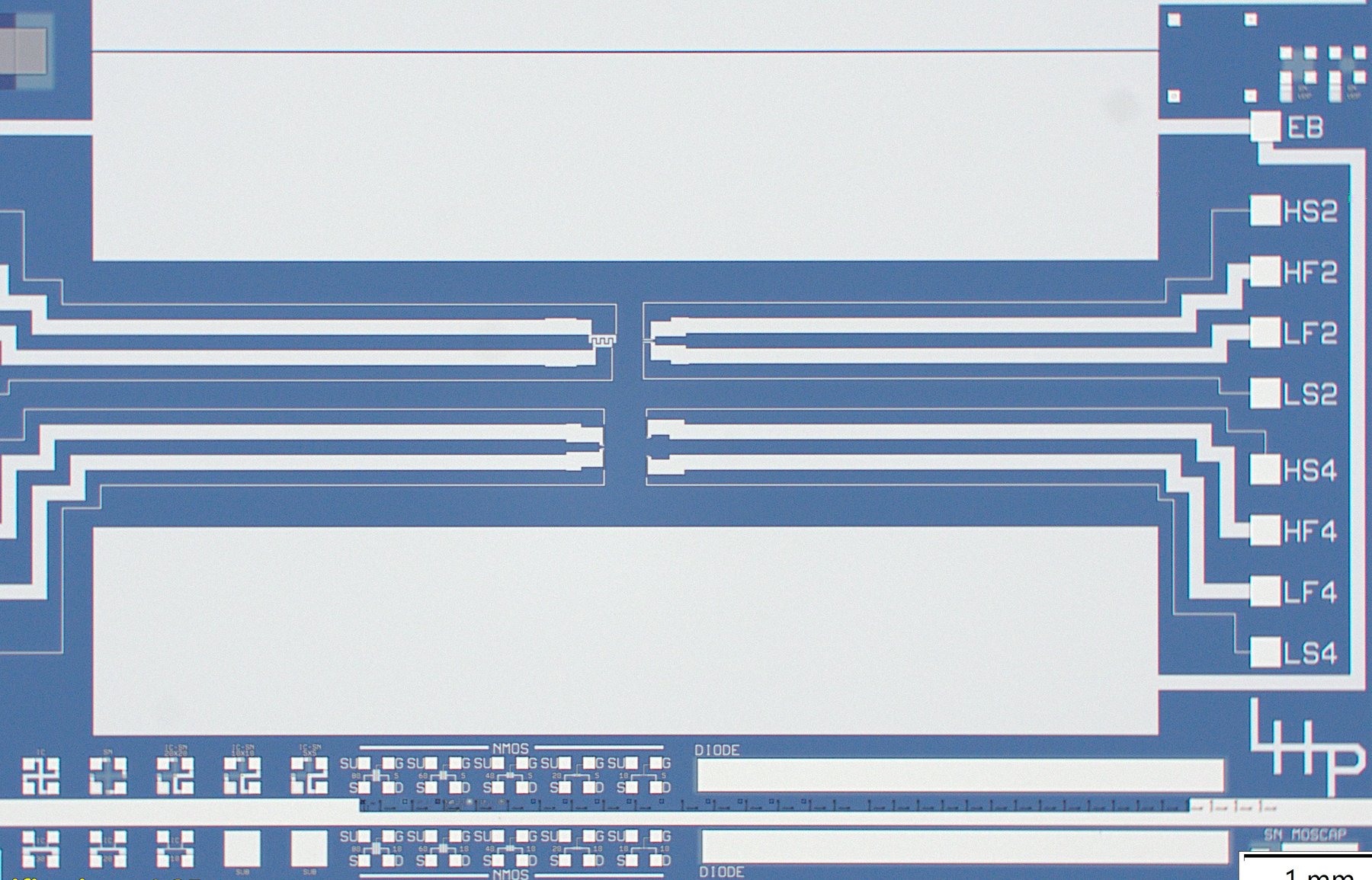
The goal of this project is to demonstrate effective analyte sensing with variations of ISFETs. Biochemical analytes of interest include ions, proteins, small molecules and reactive oxygen species, among others. The choice of target analyte will depend on the student’s interests, the intended application and gaps identified by the student in the literature. The desired sensitivity and selectivity can be achieved either with a single ISFET featuring a functionalised surface or with multiple ISFETs, each with different sensitivities, where the combined readout determines the overall response. A microchip and test platform will be provided to allow the student to evaluate different sensing layers and surface modifications early in the project. Once the appropriate functionalisation approach is identified, the student will integrate it into a working chip for the chosen application through design and fabrication.
Assignment
The project will have a duration of 9 months (45 ECTS) or 12 months (60 ECTS), and will involve the following tasks.
- Literature review to identify research gaps and desired applications
- Design and evaluate functionalised sensing surfaces with existing test platform
- Design of CMOS compatible FET-based microchip sensor
- Hands-on cleanroom fabrication in EKL and Kavli
- Characterisation of fabricated microchip in vitro
- Share progress, challenges and results in regular meetings
- Write thesis
Daily supervisor: Lars Pantleon (l.h.pantleon@tudelft.nl)
Requirements
You are an ambitious, hands-on Master student with a background in microelectronics or applied physics. You have an affinity for working in a multi-disciplinary context, including microfabrication, design and characterization of devices. You have good communication skills in English, you are independent and a team player.
Contact
dr. Massimo Mastrangeli
Electronic Components, Technology and Materials Group
Department of Microelectronics
Last modified: 2026-02-09