MSc thesis project proposal
Early Prediction of SiC MOSFET Gate Oxide Failure Using Generative AI
Background
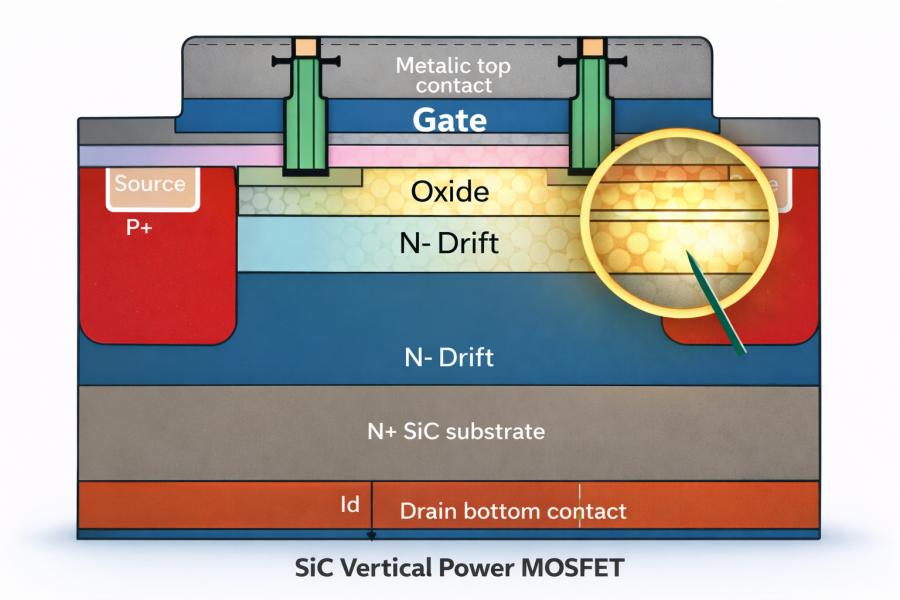
Silicon carbide (SiC) MOSFETs enable high-efficiency, high-power converters, but long-term reliability is often limited by gate oxide degradation, which can cause threshold-voltage drift, parameter instability, and eventual failure. Reliability studies generate large volumes of measurements across different operating conditions, such as Rds(on) mapped versus junction temperature and gate voltage, Vth trends versus temperature, detailed Cgs/C–V sweeps, and switching behavior extracted from double pulse tests (Eon, Eoff, ton, dv/dt-related indicators). The challenge is that these signals are multi-dimensional and strongly dependent on conditions like temperature and drive voltage, which can hide subtle early degradation. Generative models such as Variational Autoencoders (VAEs) are well suited to learn compact representations of complex data and detect patterns that deviate from “healthy” behavior. By training a condition-aware model, we can separate normal temperature/drive effects from true degradation signatures and obtain a health embedding that evolves with stress.
This project will investigate whether latent-space drift, reconstruction error, or learned feature trends can act as early predictors of gate oxide failure. The work connects advanced AI with real device physics, aiming for both practical prediction and insight into the degradation mechanisms.
Assignment
Duration: 9 to 12 months
Location: ECTM & DCE&S (Faculty EEMCS)
Tasks:
Use generative AI (e.g., a Variational Autoencoder) to learn a compact “health state” of SiC MOSFETs from measurement data.
Develop an early-warning indicator for gate-oxide degradation (anomaly score / latent drift).
Validate the indicator on a relevant use case, such as stressed devices.
Deliver a reproducible Python pipeline and clear report showing which measurements are the strongest predictors of oxide failure.
Reporting.
Contact:
Filip Simjanoski, f.simjanoski@tudelft.nl
Requirements
You are a motivated Master student with microelectronics, power electronics or data science background. You are creative, able to work independently, and fluent in English.
Contact
prof.dr.ir. Willem van Driel
Electronic Components, Technology and Materials Group
Department of Microelectronics
Last modified: 2026-02-09