MSc thesis project proposal
State-Space Modeling of Collective Neural Activity
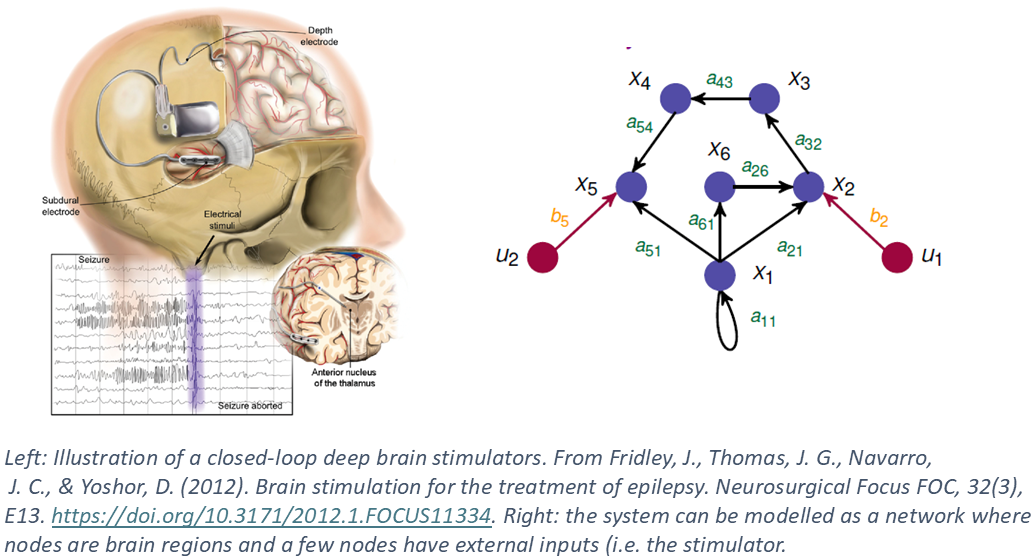
The human brain is a highly complex network of interconnected regions that continuously exchange information, a phenomenon known as functional connectivity. Understanding this communication is important for studying brain activity and interpreting signals such as electroencephalography (EEG). However, brain signals measured using EEG represent large-scale electrical activity, while the underlying processes occur at the level of individual neurons, making direct modeling computationally challenging.
To bridge this gap, researchers use simplified models that describe the collective behavior of groups of neurons rather than modeling each neuron individually. This project focuses on understanding how brain activity can be modeled using engineering system models.
Assignment
One modeling approach is the neural mass model, which represents a small brain region as a single dynamic system that captures the average activity of thousands of neurons. The goal of the project is to express the model in state-space form suitable for digital signal processing and simulation. Through mathematical derivation and simulation, the project will analyze system stability, study oscillatory brain behavior, and evaluate the limitations of the state space model compared to the original model. The goal is to connect neural modeling concepts with familiar control and signal processing techniques.
This project is jointly supervised by Bori Hunyadi (borbala.hunyadi@maastrichtuniversity.nl) and Geethu Joseph
Requirements
We are looking for a student from electrical engineering, control engineering or biomedical engineering with a strong mathematical background, e.g. with a BSc background either in electrical or mechanical engineering. Good linear algebra skills are required.
Contact
dr. Geethu Joseph
Signal Processing Systems Group
Department of Microelectronics
Last modified: 2026-02-12